
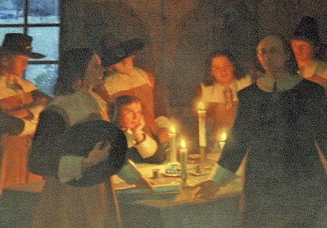
On this day in 1633, the little Puritan and Pilgrimcongregation at Newton, in the fledgling Massachusetts Bay Colony—since renamedCambridge—held a day of fasting and prayer at the end of which they choseThomas Hooker as their pastor. Hooker had only arrived in the colony theprevious month, but his zeal for the doctrines of grace and his pastoralqualifications had been amply demonstrated in years of difficult service inEngland.
Born in 1586 in Leicestershire, Hooker studied theology atCambridge University and became a popular lecturer and an able assistant to therector of the parish church in Chalmsford. Though Hooker accepted the most ofthe doctrines of the Church of England, he did not believe its liturgy orecclesiology was Biblical—in other words, he was a dissenter when it came toworship and church government. Accordingly, in 1630 he came under thediscipline of Archbishop Laud—a fierce persecutor of nonconformity. When he wassummoned to appear before the dreaded High Commission, Hooker fled to Hollandwhere he preached to exiled Puritans in both Delft and Rotterdam. He became anassistant to the renowned theologian, William Ames and wrote a pamphletentitled, A Fresh Suit against Human Ceremonies in God’s Worship.
In 1633, Hooker, along with the Puritan preachers JohnCotton and Samuel Stone, fled to America aboard the Griffen. When thethree prominent men arrived in Boston in September, several Puritans quippedthat they now had “Cotton for their clothing, Hooker for their fishing,and Stone for their building.” It was not surprising that the Newtoncongregation so quickly chose Hooker as their pastor.
In Massachusetts, however, Hooker began to question the formof government established by the Massachusetts Bay Colony. He questioned thevalidity of a church covenant forming the basis for a civil government. Hookerdid not believe that participation in the government should be limited tochurch members. Rather, he asserted that all civil government should be basedon voluntary submission to some kind of civil covenant, just as the churcheswere established on a covenant in spiritual things. The foundation ofgovernment, he thought, lay in the free choice of the people, who were tochoose public officials according to God’s will and law. Hooker’s views ongovernment were much more democratic than those espoused by the leaders of theMassachusetts Colony.
Because of these differences, Hooker peacefully leftMassachusetts with a number of members from his Newton congregation andestablished the town of Hartford in Connecticut. In 1638, three of theConnecticut towns met to form a government. In a sermon preached to the GeneralCourt at that time, Hooker maintained that the foundation of governmentauthority is “laid in the free consent of the people, that the choice ofpublic magistrates belongs unto the people by God’s own allowance.” Thetext from which Mr. Hooker derived his sermon was Deuteronomy 1:13, “Takeyou wise men, and understanding, and known among your tribes, and I will makethem rulers over you.”
The resulting government which was formed, TheFundamental Orders of Connecticut, was the first written Constitution inAmerica.
