
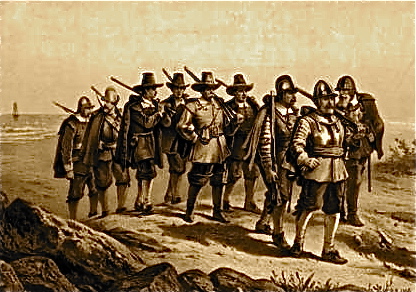
The Mayflower was not the first ship ofcolonists to arrive in the New World. It was not even the first in the English domains. Yet it retains a place of first importancein the lore and legend of this land.
In this romantic verse by Margaret Preston, we catch a glimpse of the faith, resolve, andbold sense of providence that the passengers of that little ship brought withthem from across the Atlantic—and that they then endowed upon all those whowould follow them:
“Ho, Rose! “quoth the stoutMiles Standish,
Ashe stood on the Mayflower’s deck,
And gazed on the sandy coast-line
Thatloomed as a misty speck.
On the edge of the distant offing;
See! yonder we have in view
Bartholomew Gosnold’s headlands.’
‘Twasin sixteen hundred and two
“That the Concord of Dartmouthanchored
Justthere where the beach is broad,
And the merry old captain named it
(Halfswamped by the fish)—Cape Cod.
“And so as his mighty ‘headlands’
arescarcely a league away,
What say you to landing, sweetheart,
Andhaving a washing-day?”
“Dear heart”—and the sweet RoseStandish
Lookedup with a tear in her eye;
She was back in the flag-stoned kitchen
Whereshe watched, in the days gone by:
Her mother among her maidens
(Sheshould watch them no more, alas!),
And saw as they stretched the linen
Tobleach on the Suffolk grass.
In a moment her brow was cloudless,
Asshe leaned on the vessel’s rail,
And thought of the sea-stained garments,
Ofcoif and farthingale;
And the doublets of fine Welsh flannel,
Thetuckers and homespun gowns,
And the piles of the hose knitted
Fromthe wool of the Devon downs.
So the matrons aboard the Mayflower
Madeready with eager hand
To drop from the deck their baskets
Assoon as the prow touched land.
And there did the Pilgrim Mothers,
“Ona Monday,” the record says,
Ordain for their new-found England
Thefirst of her washing-days.
And there did the Pilgrim Fathers,
Withmatchlock and axe well slung,
Keep guard o’er the smoking kettles
Thatpropt on the crotches hung.
For the trail of the startle savage
Wasover the marshy grass,
And the glint of his eyes kept peering
Throughcedar and sassafras.
And the children were mad with pleasure
Asthey gathered the twigs in sheaves,
And piled on the fire the fagots,
Andheaped up the autumn leaves.
“Do the thing that is next,”saith the proverb,
Anda nobler shall yet succeed:
‘Tis the motive exalts the action;
‘Tisthe doing, and not the deed;
For the earliest act of the heroes
Whosefame has a world-wide sway
Was–to fashion a crane for a kettle,
Andorder a washing-day!
