
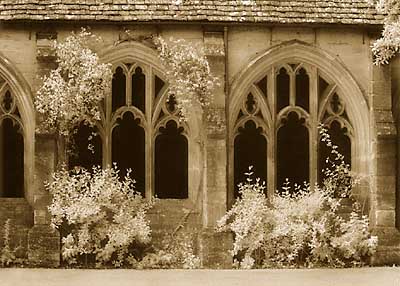
Few provincial cities anywhere are more crowded withincident and achievement than the English University city of Oxford. In a shortstroll visitors may pass the house where Edmund Halley discovered his comet;the site of Britain’s oldest public museum, the Ashmolean; the hall wherearchitect Christopher Wren drew his first plans; the pub where Thomas Hardyscribbled his notes for Jude the Obscure; the track where RogerBannister ran the first sub-four-minute mile; the meadow where a promisingyoung mathematician named Charles Lutwidge Dodgson refined The Formulae ofPlane Trigonometry, An Elementary Treatise on Determinants and, of coursehis famous children’s trifle called Alice’s Adventures in Wonderland.
Walk down the broad and curving High Street, thought by manyto be the most beautiful in England, or through the maze of back lanes thatwander among the golden, age-worn college buildings, and visitors may follow inthe footsteps of Samuel Johnson, Adam Smith, Edward Gibbon, Jonathan Swift,John Donne, Roger Bacon, Cardinal Wolsey, Oscar Wilde, Graham Greene, EvelynWaugh, T. S. Eliot, C. S. Lewis, Percy Bysshe Shelley, Indira Gandhi, andMargaret Thatcher, to name just a few who have worked and studied here.
The heart of thecity is Carfax—from the Latin quadrifurcua,”four-forked”—from which themain streets run to the four points of the compass. This was the center of the walled medieval city—built on thefoundations of an early Saxon trading settlement which was located near theford in the river there.
It was in thisremarkable environment on this day in 1921 that the esteemed professor ofetymology, J.R.R. Tolkien, began to recount the stories of Bilbo andFrodo Baggins, Hobbits of Middle Earth—one of the most remarkable achievementsin English literature.
John Ronald Reuel Tolkien, was born in South Africa in1892. After a brilliantundergraduate career, he became a medieval scholar, philologist, and professorat the university. His scholarly workat concerned Anglo-Saxon and medieval literature.
His depth and breadth of scholarship is most evident in theepic works he created about the fantasy world he called Middle Earth. He wroteThe Hobbit in 1937 as a children’s book. Its sequel, the trilogy entitled TheLord of the Rings—finally published after much anticipation in 1954 and1955—included The Fellowship of the Ring, The Two Towers, TheReturn of the King. The workis an imaginative masterpiece that has captured the imagination of generationsever since. It is a profound taleof the conflict between good and evil told against a backdrop of rich cultures,vibrant characters, and stunning prose and poetry.
Tolkien’s close friend and fellow professor, C.S. Lewis,commented that “such a tale, told by such an imaginative mind, could only havebeen spawned in such a place as Oxford.”
